
The Estatuto da Pessoa Idosa (Elderly Statute) states that people 65 years and older have the right to free fares on urban and semi-urban public transport.
To use the benefit, it is enough to present an official document that proves age; many cities also issue a free senior transport card.


Local rules may expand coverage for people between 60 and 64, depending on municipal or state legislation.
What the Federal Law Guarantees
Article 39 of the Elderly Statute secures free fares for those 65+ in urban and semi-urban systems and requires 10% of seats to be reserved for seniors.
To access the benefit, the person only needs to show any personal document that proves their age; no special card is required by federal law.
Cities and states, however, may offer or require a local card to pass automated gates more easily.
In practice, this card helps with boarding and integration between buses, the metro, and trains.
Rules
The statute allows local governments to define conditions for the 60–64 age group.
Many municipalities extend the benefit to age 60 and run their own card programs administered by transit operators.
Because rules vary, seniors should always check the operator responsible for their city or metropolitan area before applying.
Who Qualifies and Where The Card Comes From
There are considerations according to your city.
Nationwide rule (65+)
Free fares on municipal buses and other urban/semi-urban systems by showing ID.
A local card is often offered to speed boarding or to integrate buses, metro, and trains.
Cities that start at 60+
In São Paulo, people 60–64 have free fares via their Bilhete Único profile, and those 65+ can request the Bilhete Único Especial – Pessoa Idosa.
In Rio de Janeiro, the Passe Sênior (Riocard Mais) serves residents 65+, while some municipalities in the state adopt 60+ by local law.
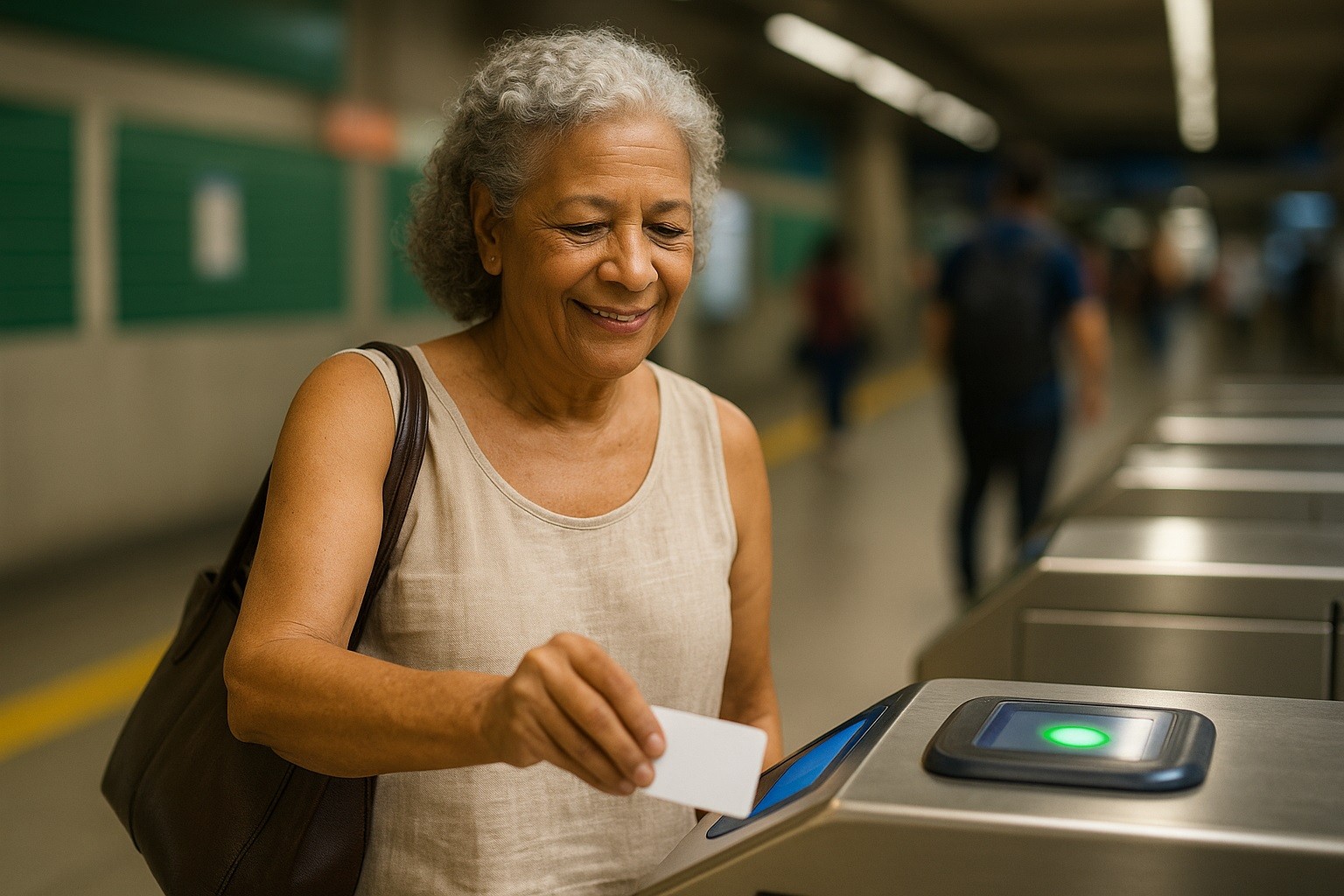
How to apply for your municipal senior card (general path)
Although each city has its own process, the steps and documents are similar across Brazil:
- Confirm eligibility on your operator’s website (age threshold, residency, and coverage area).
- Gather documents: ID (RG or other official photo ID), CPF, a recent proof of address, and a recent photo (if required).
- Request the card online or book an in-person appointment at an accredited service post.
- Receive the card at home or pick it up as instructed and activate it per the operator’s guidance.
Examples
Rio de Janeiro (Riocard Mais). Seniors apply for the Passe Sênior with online pre-registration and scheduling.
Guidance for the first issue and the second copy is published by the operator, including which documents to bring and where to collect the card.
Example: São Paulo (SPTrans). Seniors typically submit RG, CPF, proof of address (often within 3 months), and a recent photo.
The request is made through the official service portal, and the card is delivered or issued at service posts, sometimes by appointment.
Using The Benefit Without a Card (65+)
If you are 65 or older and do not yet have a local card, federal law allows you to board for free by showing a document that proves your age.
This applies to urban and semi-urban services and does not depend on prior registration.
Operators may still recommend the local card to pass turnstiles and to integrate modes (bus/metro/train) without staff assistance.
Interstate Travel: The “Carteira da Pessoa Idosa”
Free city transport is different from interstate (between states) travel.
For interstate bus, train, or boat services, the rules guarantee, on conventional services, two free seats per vehicle for older adults.
Once these seats are taken, other seniors in the same income bracket have a minimum 50% discount.
To prove low income easily at the ticket counter, the Federal Government offers the Carteira da Pessoa Idosa (also called Carteira do Idoso).
Carteira da Pessoa Idosa
Available online for people 60+ who are registered in CadÚnico and have an income of up to two minimum wages.
You can issue it on the official portal and present it with your ID at the company counter to request your free or discounted interstate ticket.
The benefit applies to conventional services in regular lines and does not extend to premium categories.
Documents Checklist (typical)
Official photo ID (RG or equivalent) and CPF. Proof of address (recent; many operators accept up to 90 days).
Recent photo, if requested by the operator.
Appointment confirmation or protocol number (when applicable).
For interstate benefit via Carteira da Pessoa Idosa: proof embedded in the digital/printed card through your CadÚnico enrollment; bring an ID as well.
Rights, limits, and good practices
Urban/semi-urban gratuity (65+): Showing an ID is enough to access free fares; seats reserved for older adults should be clearly marked. Some premium or “selective” services may not be included.
Local variations (60–64): Benefits for this age group depend on local law and operator rules. Always confirm with your city’s transit authority or operator page.
Interstate trips (low-income 60+): Request the Bilhete de Viagem do Idoso at the ticket counter using your Carteira da Pessoa Idosa and an ID. The benefit is restricted to conventional services; ancillary fees like terminal use may not be covered.
Avoid intermediaries: Use only official websites and listed service posts. Issuance is free; beware of people who charge to “facilitate” the card.

Frequently Asked Points
Do I need a special card if I am 65+?
- No. By federal law, showing an ID that proves age is enough to access free fares in urban/semi-urban services. Many systems still recommend or require a local pass to cross turnstiles and integrate different modes.
What about metro and trains in big cities?
- Metropolitan systems usually integrate benefits through the same senior card used on buses. Check the operator’s instructions because activation or profile update may be necessary in integrated networks.
How do I replace a lost or damaged card?
- Follow the operator’s second-copy procedure and bring the original documents requested (ID/CPF). Operators typically provide dates and required documents for pickup at the scheduled location.
How do I prove income for interstate free seats?
- Issue the Carteira da Pessoa Idosa online (60+, CadÚnico, income up to two minimum wages) and present it with your ID at the counter. The card includes verification data and is accepted across interstate companies for conventional services.
Conclusion
Brazil guarantees seniors’ right to mobility and makes the process practical.
These steps help you access the benefit safely and consistently, ensuring more independence and easier access to essential services.